How Long Does It Take to Sell a House in Clarksville, TN? (2026 Complete Guide)

If you're thinking about selling your home in Clarksville, the timeline question matters more than almost any other. It affects when you list, how you price, whether you can coordinate a purchase on the other end, and if you're military whether your PCS orders and your closing date have any chance of aligning.
The honest answer is: it depends on your home, your price, and your timing. But there's a real range, and I'm going to walk you through every factor that controls where you fall within it. We'll cover current days-on-market data, the Clarksville seasonality that's driven by Fort Campbell's PCS cycle, what separates a home that sells in 30 days from one that sits for 90, and the full timeline from the day you decide to sell to the day you hand over keys.
Table of Contents
- The Current Market Reality: What the Numbers Actually Say
- The Full Timeline: From Decision to Closing
- The Clarksville Seasonality Every Seller Needs to Understand
- What Separates a 30-Day Sale from a 90-Day Sale
- How Pricing Affects Time on Market More Than Anything Else
- The Role of Condition and Presentation
- The PCS Seller: Selling on a Military Timeline
- What Happens When a Home Sits Too Long
- A Real Story: Two Sellers, Same Neighborhood, Different Outcomes
- What to Do Right Now If You're Thinking About Selling
1. The Current Market Reality: What the Numbers Actually Say
Let's start with the data. As of mid-2026, homes in Clarksville are averaging 74–79 days on market from listing to contract, depending on which data source you reference, Redfin puts it at 79 days, Houzeo at 75.5, and aggregate multi-platform data from HomeLight closer to 57 days when accounting for different DOM measurement methodologies.It might go without saying that as a real estate agent, I put my trust in the MLS data, which says listing to contract is averaging 56 days while listing to sold is averaging 99 days. Please be sure to not the difference in those two measurements.
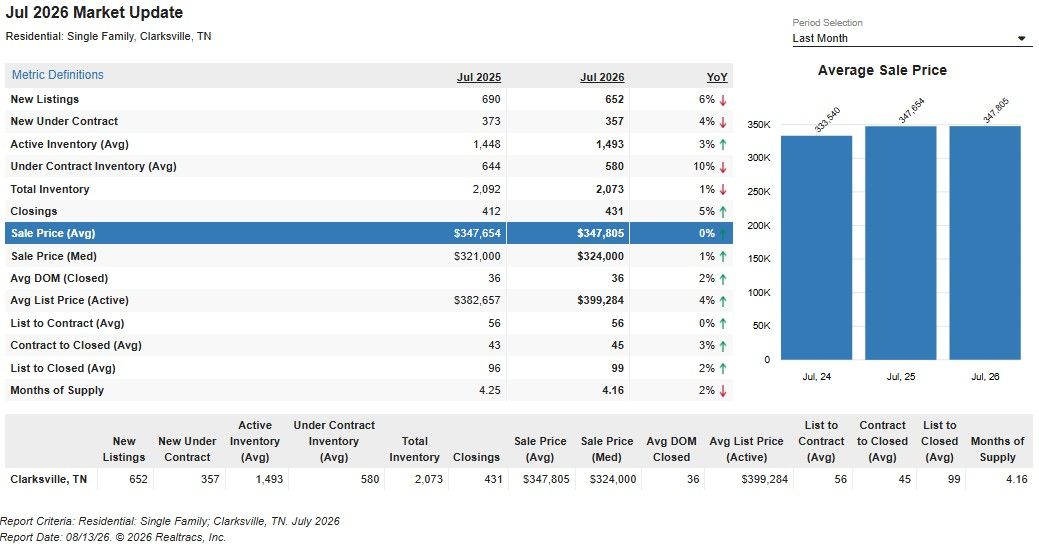
The number that matters in practice: plan for 60–90 days from active listing to contract for a well-priced, well-presented home in today's market. Add another 30–45 days for closing once you're under contract, and your full seller timeline from listing to funded sale runs approximately 90–135 days in most cases.
That's meaningfully longer than the market we saw in 2021–2022, when homes were going under contract in under 30 days and oftentimes in just a matter of hours. Today's market is balanced, with 3.95 months of supply and properties averaging 75.5 days on market, both buyers and sellers have equal opportunity to achieve favorable outcomes. That balance is actually good news for sellers who are prepared: homes are selling for 98.16% of asking price, meaning well-priced homes are still transacting close to list with minimal haircut.
The context that matters: the average time to sell a house in Tennessee is 93 days, accounting for 61 days on market and 32 days to close once an offer is accepted. Clarksville's 74–79-day average is slightly faster than the Tennessee state average, reflecting the market's structural demand floor from Fort Campbell.
2. The Full Timeline: From Decision to Closing
Most sellers underestimate how much time the process takes before the sign goes in the yard. Here's a realistic full-picture breakdown:
Phase 1: Pre-Listing Preparation (2–6 weeks) This is the phase that determines everything downstream. A home that hits the market clean, repaired, staged, and professionally photographed generates far more early momentum than one rushed to market. Realistically:
- Decluttering and deep cleaning: 1–2 weeks
- Minor repairs (paint touch-ups, fixture replacements, landscaping): 1–3 weeks
- Staging (full staging or owner-occupied staging): 1–2 weeks
- Professional photography and video: 2–3 days (scheduling + delivery)
- Pricing analysis with your agent, listing agreement, MLS input: 1 week
If your home is in good condition and you move efficiently, pre-listing prep can compress to 2–3 weeks. If you're dealing with deferred maintenance or significant updates, budget 4–6 weeks before you're ready to list.
Phase 2: Active Listing to Contract (60–90 days average, 30–45 for well-priced homes) This is the DOM clock, from the day your home hits the MLS to the day you accept an offer and go under contract. Pricing, condition, marketing, and timing are the primary drivers. More on each of these below.
Phase 3: Under Contract to Closing (30–45 days) Once you're under contract, the clock shifts to the buyer's timeline. Key milestones:
- Home inspection: typically days 5–10
- Inspection negotiation (if applicable): days 10–15
- Appraisal ordered and completed: days 10–21 (VA appraisals can run longer)
- Lender underwriting and clear-to-close: days 21–35
- Final walkthrough: day before or day of closing
- Closing: day 30–45
VA loan closings, which represent a significant portion of Clarksville transactions, can take 35–45 days due to appraisal scheduling. Conventional loans typically close in 30–35 days. Cash closings can happen in as little as 7–14 days when both sides are motivated.
Total realistic timeline from decision to funded:
- Fast scenario (priced right, great condition, spring market): 60–75 days
- Average scenario: 90–120 days
- Slow scenario (overpriced initially, price reduction needed): 120–180+ days
3. The Clarksville Seasonality Every Seller Needs to Understand
Clarksville's real estate calendar doesn't follow the typical Tennessee pattern, it follows Fort Campbell's PCS cycle. This is one of the most important market dynamics I explain to every seller, and it's the piece that most national real estate websites get completely wrong about this market.
The PCS-driven season (February–August): Fort Campbell's primary PCS window runs from late spring through summer. Soldiers receiving orders typically report to their new duty station between May and August, which means the families being replaced here are also moving out during that window, and the families moving in to Fort Campbell are actively searching for homes from February through July.
The busy season in Clarksville is typically May, June, and July, when Fort Campbell conducts its PCS transfers. This is when buyer demand is highest, days on market are shortest, and offers come in at or closest to list price. The market is typically slower between the end of November and early March.
May is the most favorable month if you want to get more money for your Clarksville home. HomeLight's transaction data also identifies July as the fastest month for Clarksville sales, with homes closing six days sooner on average than any other month.
What this means practically for sellers:
| Season | Market Conditions | Strategy |
|---|---|---|
| February–April | Demand building, inventory low, PCS orders arriving | Strong listing window; motivated buyers locking in ahead of summer |
| May–July | Peak demand, PCS season in full swing | Best chance for top-dollar, fastest DOM |
| August–October | Market slowing, inventory higher, buyers more selective | Still workable; price competitively |
| November–January | Slowest period, fewer active buyers | Serious buyers only; may need to wait or price aggressively |
The pre-Memorial Day window specifically: Mid-April to early May is the "Goldilocks" window for sellers. Listing during this time allows you to capture early shoppers before the massive Memorial Day surge. In Clarksville's context, that means getting your home on the market in April gives you maximum exposure to the PCS-driven demand wave before competing inventory also peaks in May and June.
If you have any flexibility on when you list, April through June is your best window in this market. Full stop.
4. What Separates a 30-Day Sale from a 90-Day Sale
In today's Clarksville market, the gap between a home that goes under contract in 30 days and one that sits for 90 is almost never the home itself. It's almost always one of three things: pricing, condition, or timing. Usually pricing.
How fast a house sells depends on a mix of pricing, location, condition, marketing, and market conditions, some of which you can control, and others you can't.
Here's what I see separate the fast sales from the slow ones in this market:
Homes that sell in 30 days or fewer:
- Priced within 1–2% of actual market value from day one
- Clean, decluttered, and in move-in condition
- Professional photos that show the home at its best
- Active MLS exposure with strong marketing from the first weekend
- Listed in the February–July window
- Seller flexible on possession date (military buyers often need 30–60 day closings)
Homes that sit 60–90+ days:
- Priced 3–5%+ above market value ("leaving room to negotiate")
- Deferred maintenance visible in photos or at showings
- Phone or amateur photos on the MLS listing
- Listed in fall or winter without competitive pricing to compensate for slow season
- Rigid seller timeline that conflicts with buyer needs
Redfin data for Clarksville shows that hot homes can sell for around list price and go pending in around 39 days, while the average home sells for about 1% below list price and goes pending in around 74 days. The difference between being a "hot home" and an average home is almost entirely within the seller's control.
5. How Pricing Affects Time on Market More Than Anything Else
I'm going to be blunt about this because it's the thing sellers most often get wrong: overpricing is the single biggest driver of extended days on market in Clarksville right now.
In a balanced market where 42.47% of listings have had at least one price reduction, the pattern is painfully clear. Sellers list high, buyers pass, the home sits, the price drops, and the listing starts carrying the stigma of extended market time. After a few weeks on the market, your home may lose negotiation power. When MLS days on market rise, buyers may worry about why the property hasn't sold.
Here's the math that matters: in today's Clarksville market, a home priced correctly from day one will typically sell at or very close to list price. A home that requires a price reduction often ends up selling for less than it would have sold for if it had been priced right initially, because the price reduction signals weakness and invites lower offers.
The "room to negotiate" myth: Sellers often want to list high to leave negotiating room. In reality, overpricing doesn't create negotiating room, it creates vacancy. Buyers in this market are financially stretched by 6.5% rates and they're doing careful payment math. A home priced $10,000 over market doesn't get offered down to market value, it often gets skipped entirely in favor of something priced right.
My approach for every listing: I do a full comparative market analysis before we set a price, not a Zillow estimate, not a county assessment, not what your neighbor thinks it's worth. Real closed sales data from RealTracs MLS, with adjustments for condition, updates, lot size, and location. That's the number we list at, and listings priced that way consistently move faster and net more than those that start high and chase the market down.
6. The Role of Condition and Presentation
Pricing gets you showings. Condition and presentation get you offers.
In today's market, buyers are cautious. Rates are elevated, monthly payments are higher than they've been in a decade, and buyers are doing more homework before making commitments. A home that looks move-in ready at the showing signals "no surprises", which is exactly what a buyer on a stretched budget needs to feel confident enough to write an offer.
Professional photography is non-negotiable. I say this because the first showing of your home happens online, not in person. A buyer searching on their phone at 10pm sees 15 homes in the same price range. The ones with bright, wide-angle, professionally composed photos get showing requests. The ones with dark, cluttered, or phone-quality photos get skipped. Staging sets your home apart. Well-staged homes photograph better and often generate more showings, which can shorten the time to an offer.
Staging matters more than sellers expect. Staged homes sell 73% faster than those that are not staged, according to NAR data. A well-staged property can sell for 5–15% above asking price. You don't need to hire a professional staging company, in many cases, working with what you have, decluttering aggressively, and rearranging furniture to open sight lines is enough.
The repairs that actually matter: Not every repair is worth doing before listing. Here's my honest assessment of what moves the needle in Clarksville:
Worth doing:
- Fresh neutral paint (interior), ROI of 107% according to staging data
- Deep cleaning throughout, including windows
- Crawlspace inspection and basic moisture remediation if needed (this is a known issue in Middle Tennessee resale)
- HVAC service and filter replacement (buyers ask about this)
- Landscaping: mow, edge, mulch, trim: first impressions are made at the curb
Probably not worth doing before listing:
- Full kitchen remodel: you won't recover the cost
- New flooring throughout: offer a credit instead
- Major landscaping projects: buyers want to make their own choices
Disclosure and transparency: Tennessee requires sellers to complete a property disclosure form covering known material defects. Being upfront about what you know, rather than hoping buyers miss it, saves deals. Buyers who discover issues after an inspection that weren't disclosed react worse than buyers who knew going in. Honesty at the disclosure stage typically keeps transactions together better than omission.
7. The PCS Seller: Selling on a Military Timeline
This section is for the significant portion of Clarksville sellers who are in the military and have a report date driving their timeline. This is a genuinely different situation from civilian selling, the timeline is non-negotiable, the consequences of missing it are severe, and the coordination complexity is real.
The core PCS selling challenge: Military relocation follows non-negotiable timelines set by PCS orders. You must report for duty by a fixed date regardless of your home sale progress. If you cannot sell before leaving, you might end up paying two mortgages at once, often $2,000 to $4,000 per month in Tennessee markets while you wait for a buyer or renter.
My recommendation for every military seller: Start the conversation with your real estate agent no later than 90 days before your report date. Earlier is better. Here's why: if you list 90 days out, you have a buffer for the average 74–79 days on market plus a 30–45 day closing timeline. That's 104–124 days total, barely workable at 90 days out, comfortable at 120 days out.
What to do when the timeline is tight:
If you have 90+ days: List at market value, market it properly, and give yourself the best chance of a full-price traditional sale. Don't panic-price, you'll leave money on the table.
If you have 60–75 days: Price 1–2% below market value to generate faster buyer interest. Target buyers with conventional or VA pre-approvals (not FHA, which can take longer). Negotiate for a buyer who can close in 30 days.
If you have 30–45 days: You're in emergency territory for a traditional sale. Consider pricing for speed, and simultaneously explore: (1) renting the home while you're gone and hiring a property manager, (2) a cash buyer who can close in 7–14 days (expect to sell below market value), or (3) whether your orders contain any flexibility on report date.
VA IRRRL and rental conversion: If you need to rent the property while PCSing, you can convert a VA-financed home to a rental without refinancing, you're just converting its use. The one thing you cannot do is buy a new home using VA financing as a primary residence while simultaneously renting out the old one, unless you have sufficient remaining entitlement. This is worth a conversation with a VA-specialized lender before you make any decisions.
8. What Happens When a Home Sits Too Long
Days on market is the metric that tells the story of a listing, and in real estate, buyers read that story carefully.
When a home in Clarksville has been on the market for 60, 75, or 90+ days, buyers start asking questions: Why hasn't this sold? What's wrong with it? Are there issues the seller isn't disclosing? Is the price still too high even after reductions?
These questions create negotiating leverage for buyers, leverage that comes directly at the seller's expense. When MLS days on market rise, buyers may worry why the property hasn't sold, which is why prepping before listing typically has a bigger impact than sellers think.
The compounding problem: the longer a home sits, the more showings it gets from buyers who aren't serious, people who are curious, comparison shopping, or who are years away from being ready to buy. These showings add to your inconvenience without producing offers. Meanwhile, the qualified, motivated buyers who viewed your home in weeks one and two have moved on.
The price reduction death spiral: Many sellers wait too long to reduce price, then reduce too little when they do. A $5,000 price reduction on a $315,000 home that's been sitting 60 days doesn't change anyone's behavior, it confirms the home is overpriced and signals the seller is reluctant to negotiate seriously. A meaningful reduction, 3–4% or $9,000–$12,000, repositions the listing in a new price tier and can generate fresh showing activity.
The re-listing conversation: Some sellers pull a listing that's been sitting too long, let it go "stale" for 30 days, and re-list it to reset the DOM counter. I want to name this because buyers' agents see through it, we can see the listing history. More practically: the underlying issue that caused the home to sit doesn't get fixed by resetting a counter. Price and condition need to be addressed regardless.
9. A Real Story: Two Sellers, Same Neighborhood, Different Outcomes
Two sellers in the same North Clarksville subdivision, both listed in the same month in early 2025. Nearly identical homes, same builder, same floor plan, similar condition, comparable square footage.
Seller A priced at $319,900 based on what they had originally paid plus the updates they'd made, rather than what the market actually supported. They figured they'd negotiate down if needed. The home sat. After 45 days and two showings, they reduced to $309,900. After another 30 days, they accepted an offer at $299,500 — $20,400 below original ask, 77 days on market. The buyer negotiated an additional $4,000 in inspection repair credits because the extended DOM had shifted the leverage entirely to the buyer's side.
Seller B came in with a full CMA at $304,900, slightly under the market ceiling to generate early momentum. Professional photos, a thorough deep clean, and basic landscaping work. Listed on a Thursday. Had three showings in the first weekend. Received an offer at $301,000 on day 8. Negotiated to $303,500 with the buyer covering most closing costs. Closed in 34 days.
Seller B netted approximately $299,500 after a minimal concession. Seller A netted approximately $295,500 after their price reduction and inspection credit. Seller B sold in 8 days. Seller A sold in 77 days. Same neighborhood, same floor plan, same market, completely different outcomes driven entirely by pricing strategy and preparation.
10. What to Do Right Now If You're Thinking About Selling
Whether your timeline is 3 months or 12 months out, here's what actually moves the needle:
If you're 4–6 months out: Start now. Walk through your home with a critical eye, or better, have your agent do it, and identify the 5–10 things that a buyer will notice first. Prioritize the high-ROI items: paint, cleaning, landscaping, any deferred maintenance that will flag on an inspection. Doing this work over 3–4 months costs far less in stress and money than doing it in a compressed 3-week sprint before listing.
If you're 2–3 months out: Get your pricing analysis done now. The market shifts quarterly, and pricing a home that lists in April based on data from December is a mistake. Have your agent pull current closed sales, not list prices, closed prices, and understand exactly where your home fits. Start your preparation work immediately.
If you're 30–60 days out (or on PCS orders): Call me today, not next week. Thirty to sixty days is a workable window, but only if we start immediately. We need to assess whether a traditional sale is realistic on your timeline, what pricing strategy gets you there fastest, and what your backup plan is if we need one.
The one thing I tell every seller regardless of timeline: Don't let the perfect be the enemy of the good. You don't need to do a $30,000 renovation to sell well in this market. You need accurate pricing, clean presentation, professional photos, and an agent who understands how to position your home for Clarksville's specific buyer pool, which includes more VA buyers, more PCS families, and more first-time buyers than almost any other market in Tennessee.
Start the conversation here → 📞 931-802-9960 📧 hleproperties@gmail.com
Landon Castillo is a licensed REALTOR® with Real Broker LLC (TN License #356633) in Clarksville, Tennessee. He specializes in VA buyers, first-time homebuyers, PCS relocations, and residential resale in the Fort Campbell and Montgomery County market. Market data reflects Redfin, Houzeo, HomeLight, and RealTracs MLS sources as of mid-2026. Individual results vary based on property condition, pricing, location, and market conditions at time of listing.
Related Reading:
Categories
Recent Posts